The Five-Minute Looking List for Concrete Creative Material
A five-minute looking list turns a vague impression into concrete details, clear relationships, and prompts you can develop into a drawing, poem, or scene.
The common mistake with a five-minute looking list is to write down what a scene means before recording what is there. “Lonely” or “peaceful” tells you how you feel, but not what to draw, describe, or develop. A wet sleeve, a tilted shadow, or a chair scraping tile gives you material you can return to and transform.
A five-minute looking list is a brief record of concrete sensory and visual details made before you explain them. A usable list preserves more than a mood: it gives you distinct objects, actions, textures, sounds, or relationships that can support a creative choice. The time limit is a prompt to notice selectively, not a demand to fill a page.
Concrete details make a looking list usable
Interpretation compresses a scene into a judgment. Observation keeps its parts available. “The station feels anxious” tells you about your mood; “a paper cup shivers beside the bench while the departure board clicks” gives you objects, motion, sound, and rhythm to work with.
Use nouns for what is present, verbs for what changes, and sensory words for qualities you can identify. “A blue scarf” names an object. “The scarf catches on a brass handle” adds an action. “A cold draft touches my wrist” records a sensation without claiming where it began.
To make the notes useful later, aim for variety rather than polish. Record a detail that could become an image, a sound, a movement, or a relationship between two things. Keep an interpretation if it matters to you, but mark it as a thought rather than an observed fact.
Choose a list format that preserves the scene
Different formats help you notice different kinds of material. Choose one that matches what is actually present; there is no need to make every scene fit the same structure.
A sensory sweep collects varied details
Make short entries under sight, sound, touch, smell, and movement. Use only the categories that offer clear information. An empty line is better than a guess.
This format suits a café table, garden, or window where several kinds of detail are easy to notice. If the setting distracts you or makes moving around unsafe, stay still and record only what you can attend to comfortably.
A single-focus list follows one strong feature
Choose a subject such as light on a stairwell, a row of shop windows, or rain on a metal awning. Note variations: where the light breaks, what a reflection hides, or how the sound changes across the surface.
This format can help when one feature keeps drawing your attention. If the notes start repeating, shift to another sense or widen your focus.
A contrast list records a real boundary
Write details from either side of a visible or sensory divide: inside and outside a doorway, shade and sun, or the near and far ends of a table. The relationship between the sides can suggest a composition without requiring you to name a theme.
Use this format only when both sides offer something observable. If the contrast is forced or one side has no distinct details, switch to a sensory sweep or a single focus.
Keep observations precise and separate from guesses
Fast notes can be fragments. “Three gulls, one missing feather,” “soap smell near the sink,” and “shadow trembles on the lid” preserve details without slowing you down. Avoid polishing each phrase while you are still looking; a tidy sentence can lose the quality that made the detail noticeable.
Separate observation from interpretation. “A person checks the door twice” describes an action; “the person is worried” guesses at a reason. If both matter, write the observation first and label the thought separately. That distinction lets you decide later whether the interpretation belongs in the work.
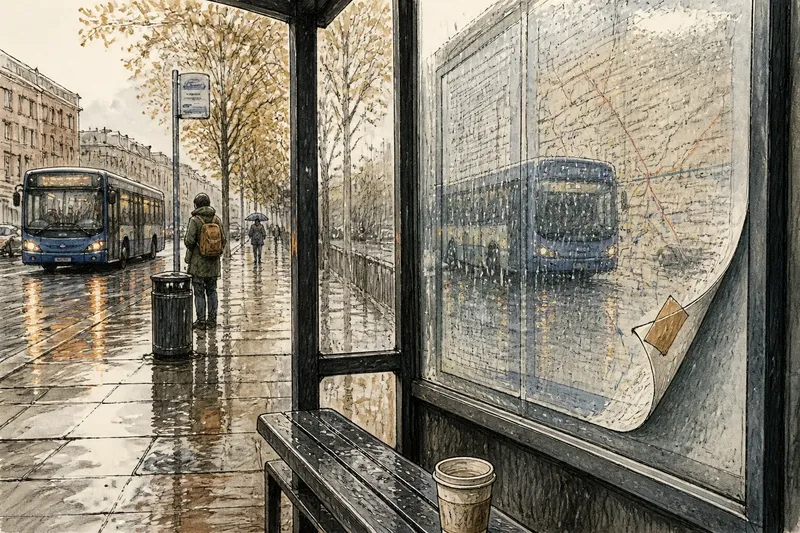
Say you are waiting beside a bus shelter and notice a route map clouded by rain, a loose corner of tape, and a bus-shaped reflection moving across the glass. You write those three observations, then add the low engine sound you can hear. The resulting list offers a blurred edge for a drawing, a moving reflection for a poem, or a setting for a scene, without deciding in advance what the place means.
Choose a looking-list format for your scene?
Which looking approach should you use?
Use a sensory sweep when several senses offer distinct details, a single-focus list when one feature keeps attracting your attention, and a contrast list when a real boundary separates two observable conditions. If none fits, write plain observations without forcing a format.
How do you keep a looking list from becoming a diary entry?
Record objects, actions, sounds, textures, and visible changes before describing your mood or the scene’s meaning. Keep any personal response separate so you can distinguish it from what you observed.
What should you do when you cannot use every sense?
Use only the senses that provide clear information. Careful visual details are more useful than guesses about smell or touch.
How many details should you record?
Stop when the list contains distinct details rather than repeated versions of the same impression. The aim is enough variety to see what makes this particular scene different.
Develop one observation into a creative prompt
After looking, read the list once and mark details that still hold your attention. Look for an action, contrast, texture, or small change that can carry into another form. A drawing might begin with a map’s blurred edge; a poem might follow a moving reflection; a short scene might turn on the difference between a familiar sign and what rain has done to it.
Not every detail needs to become a project. Some notes are records, and others may work better beside details from another visit or in an imagined setting. Keep the wording that made the observation visible, then choose a form that can use it.
A five-minute looking list is usable when it leaves you with concrete material and a choice: an object to draw, a sound to shape into rhythm, a movement to describe, or a relationship to explore. When an impression feels too vague, return to what is physically present, what is changing, and what your senses can confirm. A seam of light or a repeated click can be enough to begin.