The Myth of the Perfect Creative Routine
A helpful creative routine supports the work without demanding a fixed schedule. Learn to spot pressure rituals and adjust your rhythm to fit real life.
The most common mistake with a creative routine is treating a fixed schedule as proof that you are doing the work properly. That belief can turn a useful practice into a source of guilt: miss a session, then spend the next one trying to make up for it. A creative routine should make it easier to return to a project, not create another standard to fail.
There is no single schedule that suits every kind of work or every life. A steady rhythm can help you protect attention and remember where you left off. But the same routine can become a ritual of pressure if its rules matter more than the work they were meant to support. The practical question is not whether you have a perfect routine. It is whether your current pattern helps you begin, continue, and return.
A creative routine is a support, not a test
A routine is a repeatable cue or sequence that helps you approach creative work. It might be a regular time, a familiar place, or a small opening action, such as reading the last paragraph before drafting. A schedule is only one possible part of that routine.
Fixed timing is useful when it fits the shape of your days. Someone with a predictable afternoon may reserve that period for drawing. Someone whose care work or shifts change each week may find a project-based cue more dependable: write after breakfast when possible, or begin each session by reviewing the last note. Both approaches can create continuity.
The purpose is to reduce the effort of deciding how to start. If the arrangement demands more energy than it gives back, it needs adjustment. Keep the part that helps you meet the work; question the part that merely proves you kept a rule.
Missed sessions create a catch-up trap
What happens: You miss a planned session and feel that the week is already spoiled. The next available block seems too small to count, so you postpone again.
What usually causes it: The routine treats attendance as the main measure of progress. That makes a missed session feel like a broken contract rather than an ordinary change in circumstances.
What to try: Decide what a useful return looks like before you need it. It might be opening the file, marking the next unresolved question, or making one small draft. Do not frame this as repayment. Its purpose is to reconnect you with the project, so the next session has a clear starting point.
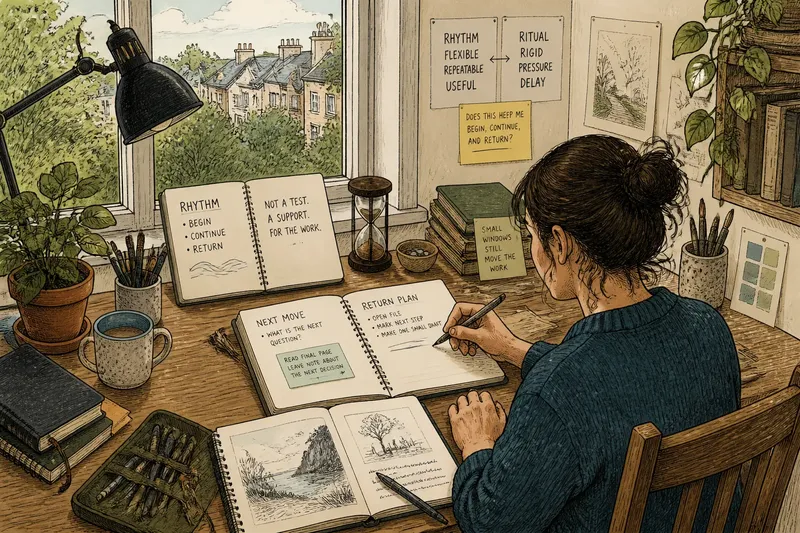
Say you planned to revise a short story on Thursday, but an unexpected errand takes the evening. On Friday, you could read the final page and leave a note about the scene’s next decision, rather than trying to recreate the missed block. The observable result is a project with a current point of entry, even if no full revision session happened.
Preparation expands until the work disappears
What happens: You arrange the desk, choose a playlist, sharpen pencils, and wait to feel ready. The preparation is orderly, but the project remains untouched.
What usually causes it: A routine can become a ritual when its opening conditions grow more elaborate than the task requires. Some setup genuinely removes friction; repeated setup may instead delay the uncertain part, such as choosing a composition or writing an imperfect first sentence.
What to try: Give the start one direct link to the work. Put the relevant sketch beside the paper, open the draft at the unfinished passage, or lay out the material you already chose. If you notice yourself adding another preparation step, ask whether it changes what you can do next. If not, begin with what is ready.
Long sessions make small windows seem useless
What happens: You believe creative work needs an uninterrupted stretch, so a short opening in the day gets dismissed. The project waits for an ideal block that rarely arrives.
What usually causes it: One task may need long concentration, but not every useful contribution does. Reading a page, comparing two versions, or writing down a question can keep a project active without pretending that a brief session is the same as an extended one.
What to try: Separate tasks by the attention they need. Reserve complex choices for a time when you can think without rushing. Use shorter openings for low-friction actions, such as gathering the tools for a drawing or noting what feels unresolved. A small session is useful when its task is appropriately small.
How can you tell whether a routine still helps?
Does a creative routine need a fixed time?
No. A regular time can help if your days allow it, but a repeating cue or a flexible weekly intention may suit you better. Choose the form that makes returning to the work more likely in your actual circumstances.
What is the difference between a rhythm and a ritual?
A rhythm makes it easier to meet the project and can bend when conditions change. A ritual becomes burdensome when you feel unable to work unless every prescribed condition is met.
How often should you revise your routine?
Revise it when it repeatedly clashes with your schedule, delays the work, or leaves you unsure how to resume. You do not need to redesign it after every difficult session; look for a recurring snag and change the part connected to it.
What should you track instead of a perfect streak?
Notice whether you can find your place, make a workable next move, and return after an interruption. These observations tell you more about the routine’s usefulness than an unbroken record of sessions.
Pressure can hide inside a routine that looks productive
What happens: You follow the schedule but feel tense before each session, or leave with little sense of what you were trying to do.
What usually causes it: The routine may have outlasted its purpose. Perhaps it was built for a previous project, a different workload, or an imagined version of your day. Keeping it unchanged can make creative practice feel like compliance.
What to try: Identify the smallest useful promise the routine can make. Instead of requiring a certain mood or a long session, decide on a clear opening action and a way to leave yourself a note for next time. If the project itself is unclear, name the next question you need to answer rather than demanding more discipline.
Change one feature at a time. If you replace the hour, location, opening ritual, and task all at once, it becomes difficult to tell which change helped. A modest adjustment gives you a clearer read on what supports your attention.
Build a rhythm around the work you have
Start by describing the actual constraint: shifting hours, a shared workspace, a project that needs quiet, or limited energy at the end of the day. Then choose a routine that responds to that constraint rather than pretending it is absent. For example, keep a draft and a short continuation note together if you often work in different places. The note is not a record of every thought; it is a handhold for re-entry.
Keep the routine provisional. A drawing project may benefit from a repeated stretch of uninterrupted looking, while a writing project may move forward through brief returns to a scene. Let the demands of the work shape the pattern, and let changes in your life reshape it when needed.
A useful creative routine is not the one you obey without interruption. It is the one that helps you recognize the next workable action and come back when you can. That is a better test of a creative routine than a flawless calendar, and it leaves room for the work to change.