Preparing a Small Work-in-Progress Share
A small work-in-progress share can turn unfinished material into useful feedback by focusing attention on one question and a clear next decision.
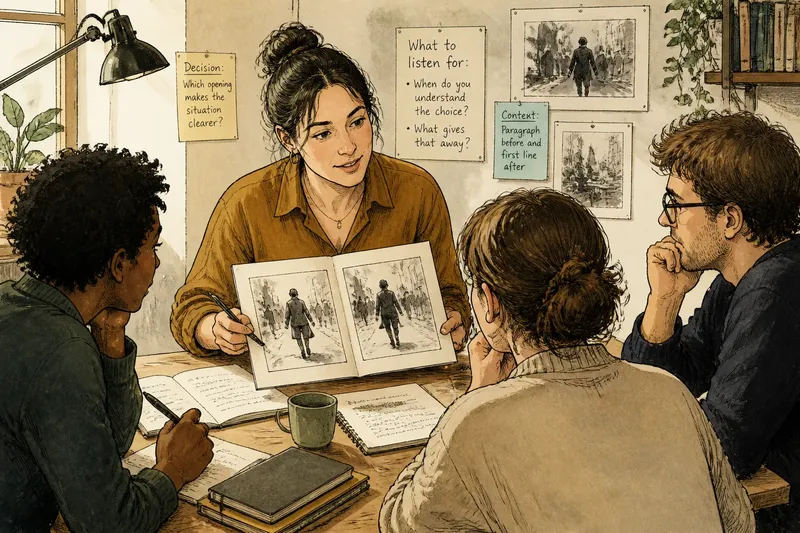
The common mistake in a small work-in-progress share is showing everything and asking, “What do you think?” The audience has to guess what matters, and you collect broad reactions that may not help you decide what to do next. A better share gives unfinished work one clear job: help you answer one question.
A useful share begins with a decision
A work-in-progress share is a brief occasion for showing selected, unfinished material and inviting responses. It is not a polished presentation, a full critique, or a request for permission to continue. Its value comes from connecting what people see to a decision you genuinely face.
Before gathering materials, complete this sentence: “After this share, I want to decide whether to…” Name an action or choice, such as keeping two scenes in their current order, redrawing a character’s posture, or making a passage more direct. “Make the project better” is too broad to guide a response.
The question should be open enough to allow useful observations, but bounded enough that listeners know where to look. “Which of these two openings makes the situation clearer?” gives people a task. “Is the whole story working?” asks them to assess many elements at once.
Choose the decision first. The material you show can then serve it.
Choose a portion that contains the question
Small does not mean arbitrary. Select a portion that lets people encounter the uncertainty in context. A single paragraph may need the sentence before it; a drawing may need its neighboring thumbnail to make a compositional choice visible. Include only the surrounding material that helps explain the decision.
For a written project, you might share a short passage with a brief note about what comes immediately before and after. For an illustration, you might show two rough versions of the same moment rather than a full set of unrelated pages. For a sound or performance idea, pair a short excerpt with a plain description of what listeners should attend to.
Say you are writing a scene in which a character decides to leave a gathering. You are unsure whether the choice feels sudden or deliberate. Share the paragraph leading into the departure and the first line after it, then ask, “At what point did you understand that the character had decided to leave?” The responses can show where the decision becomes legible and help you decide whether to revise the lead-in.
Do not conceal every rough edge. If the roughness affects the question, make it visible and name it. If a layout is only a placeholder, say so briefly, so people do not spend their attention judging the placeholder instead of the choice you want to discuss.
Prepare a frame that protects attention
A little context helps an audience respond without turning the share into a long explanation. Offer only what they need to understand the material and your question: what the work is, where the excerpt sits, and which decision is open. Avoid defending the work before anyone has seen it. A defense can steer people toward reassurance rather than observation.
For example, you might say: “This is a draft of a short scene about a missed connection. I’m deciding whether the final exchange should stay indirect. Please listen for what you understand about each person’s intentions.” That frame names the uncertainty while leaving room for an honest response.
Set a modest boundary around the share. Let people know whether you want written notes, spoken impressions, or a short discussion. If the group is large, ask listeners to write before anyone speaks; that gives each person a chance to form an independent response. Keep the work itself at the center, not the history of every change that led to it.
- Check whether you can state the decision in one sentence. If you can, use it to focus the share; if you cannot, narrow the decision before inviting responses.
- Check whether the excerpt includes enough context to make the question understandable. If it does, keep the excerpt; if it does not, add the nearest passage, image, or moment that supplies the missing context.
- Check whether an unfinished element could distract from the question. If it could, name it as unfinished; if it cannot, leave it unmentioned and keep attention on the decision.
- Check whether your question points to an observable response, such as what a reader understood or where attention shifted. If it does, ask it; if it does not, rewrite it to invite a specific observation.
- Check whether people know how to respond. If written notes, spoken impressions, or discussion suit the group, state that format; if not, choose a format that lets everyone respond without crowding out quieter voices.
- Check whether you are choosing the scene’s order or seeking line edits. If order is the decision, set line edits aside for now; if sentence-level wording is the decision, invite comments on the relevant lines instead.
These checks keep the occasion small enough to be useful.
Ask for observations before suggestions
Feedback often arrives as a proposed fix: add a sentence, remove a character, change the color. Suggestions can be helpful, but they are easier to assess after you understand what prompted them. Ask first what people noticed, understood, or expected. Those responses give you information about the work’s effect without making another person responsible for your decision.
Questions that invite observation include: “What did you think the speaker wanted?” “Which detail stayed with you?” and “Where did your attention shift?” Each points toward something a listener can report. By contrast, “Did you like it?” usually produces a preference without explaining what in the work shaped it.
You can also separate different kinds of response. A person may understand the sequence but feel little tension; another may be moved by a moment but unsure why it occurs. Those are distinct observations. Ask follow-up questions only when an answer bears on your decision. The aim is not to interrogate the audience or gather a complete review.
If an answer is unclear, try a neutral prompt such as, “What in the passage gave you that impression?” Then listen without correcting the person’s reading. A response you disagree with can still reveal that the work permits an interpretation you had not intended.
Keep the next decision in your hands
Feedback is information, not an instruction list. People respond from their own preferences, experiences, and attention. One person may ask for more explanation while another enjoys the ambiguity. Neither response automatically settles what the work should become.
During the share, note the response in plain terms. Record what someone noticed separately from what they advised. “The entrance felt abrupt” is an observation; “add a paragraph of backstory” is one possible remedy. Keeping those apart lets you consider other ways to address the same effect, or decide that the effect is intentional.
Afterward, return to the question you brought. Sort comments into three groups: evidence that helps answer it, ideas you may revisit later, and suggestions that do not fit the project’s direction. You do not need to use every comment. Choose a manageable next action, then make it on your own terms.
For a first share, consider one trusted reader or a small group whose familiarity suits the work. Someone close to the project may understand its context; someone new may notice where the page needs to carry more of that context. The right audience depends on the decision, not on an abstract ranking of who gives the best feedback.
What should you ask people to notice?
Should I ask whether people like the work?
Ask about liking only if preference is directly relevant to your decision, such as choosing which of two tones to pursue. Otherwise, ask what people understood, noticed, or expected; those answers explain more than a simple approval or rejection.
How much unfinished work should I show?
Show the smallest portion that still lets people encounter the question in context. Add a neighboring passage, image, or moment only when leaving it out would make the response misleading or difficult.
What if people give advice I did not request?
Thank them, then return to your question by asking what in the work led to the suggestion. You can keep the observation and set aside the proposed fix without making the exchange adversarial.
What if the feedback conflicts?
Look for the specific reactions underneath the disagreement. Different readings may show that the material supports more than one interpretation, which may be useful if your decision concerns clarity, tone, or deliberate ambiguity.
End the occasion with a usable next move
Close by repeating the question you came with and naming what you heard, not by asking the group to reach a verdict. You might say, “Several people understood the choice only after the final sentence, so I’ll consider bringing that cue earlier.” This makes the discussion concrete while leaving authorship with you.
Then choose a next action small enough to begin: revise the transition, compare the two sketches again, or leave the passage alone while you work on the surrounding scene. A work-in-progress share earns its place when it changes how you approach that decision, even if it does not settle the answer at once.
For your next small work-in-progress share, write the question on a card beside the excerpt. If the material and the question do not fit together at a glance, narrow the share before you invite anyone in.